
25 Wild Facts About South Africa That Breaks Your Brain
Geography Facts About South Africa You Never Knew
South Africa is one of the most geographically diverse countries on Earth — but most people have no idea just how incredible it really is. Tucked into the southern tip of the African continent, this single nation manages to pack in three surrounding oceans, towering mountain ranges, a canyon deep enough to rival some of the world’s most famous gorges, deserts, penguin colonies, and rock formations older than complex life itself. In this video, you’ll discover 25 wild facts about South Africa that sound unbelievable but are completely true.
A Country Surrounded by Water on Every Side
Most people know South Africa touches the Atlantic and Indian Oceans, but few realize just how dramatic that meeting point actually is. Cape Agulhas, not the more famous Cape of Good Hope, marks the true southernmost tip of the African continent — and it’s where the cold Atlantic and warmer Indian Ocean waters are said to converge. Along the way, the country’s coastline stretches for more than 3,000 kilometers, making it one of the longest coastlines on the entire continent. Few nations offer such a dramatic collision of ocean currents, climates, and marine ecosystems within a single stretch of shoreline — a collision that’s also responsible for the thriving marine life along the Cape Town coast.
Photo: Cape Agulhas, the true southernmost tip of Africa
The Kingdom Swallowed Whole
Here’s a fact that sounds impossible: South Africa completely surrounds another sovereign nation. The Kingdom of Lesotho, nicknamed the “Kingdom in the Sky,” sits entirely within South African borders, making it one of only three countries in the world fully enclaved by a single neighbor. Lesotho’s claim to fame doesn’t stop there — because its territory rises so high into the Drakensberg Mountains, it’s the only country on Earth where every square inch of land sits above 1,000 meters in elevation. Much of South Africa’s own water supply actually flows down from Lesotho’s snow-capped peaks, creating a strange and vital interdependence between the two nations.
Mountains, Canyons, and a Landscape That Shouldn’t Exist
The Drakensberg range itself, whose name literally translates to “Dragon’s Mountain,” features jagged peaks soaring past 3,400 meters and forms a natural wall separating South Africa’s coastal lowlands from its high interior plateau — the same range that cradles the enclaved Kingdom of Lesotho. Further north, the Blyde River Canyon carves through the landscape as one of the largest canyons on the planet — and it holds the distinction of being the largest “green” canyon on Earth, meaning it’s covered in lush subtropical vegetation rather than bare rock, unlike most of the world’s other giant canyons. And despite a climate most people associate with sunshine and safaris, the Drakensberg gets cold enough in winter to support actual skiing and snowboarding.
Photo: The Drakensberg Mountains, the “Dragon’s Mountain” range
Photo: Blyde River Canyon, the world’s largest “green” canyon
Rocks Older Than Almost Anything on the Planet
South Africa’s geology reaches back further than nearly anywhere else on Earth. The Barberton Makhonjwa Mountains contain rock formations dated at over 3.5 billion years old, among the oldest and best-preserved fragments of the planet’s early crust ever found — a geological time capsule from an era before complex life existed. The Vredefort Dome, meanwhile, marks the site of the largest and oldest verified meteorite impact crater on Earth, the scar of a collision that occurred roughly two billion years ago — ancient ground not far from where scientists later uncovered some of the oldest human ancestor fossils on the planet.
The Cradle Where Humanity Began
Just northwest of Johannesburg lies a network of limestone caves known as the Cradle of Humankind, a UNESCO World Heritage Site where paleontologists have unearthed some of the oldest hominid fossils ever discovered, some more than two million years old. It’s one of the richest sources of early human ancestor remains anywhere on the planet, and it’s fundamentally reshaped scientists’ understanding of where — and how — the human story began.
Photo: The Sterkfontein Caves at the Cradle of Humankind
A Botanical Kingdom Unlike Any Other
Centered around Cape Town, the Cape Floral Kingdom is one of only six recognized floral kingdoms on the entire planet, and it’s by far the smallest. Despite covering an area roughly 40 times smaller than the British Isles, it contains more plant species than the British Isles do — over 9,000 species of fynbos vegetation, roughly 6,000 of which grow nowhere else on Earth. It’s a biodiversity hotspot so concentrated that botanists travel from around the world just to study it, and the region is protected today as one of South Africa’s ten UNESCO World Heritage Sites.
Photo: Fynbos vegetation in the Cape Floral Kingdom
Penguins on African Beaches
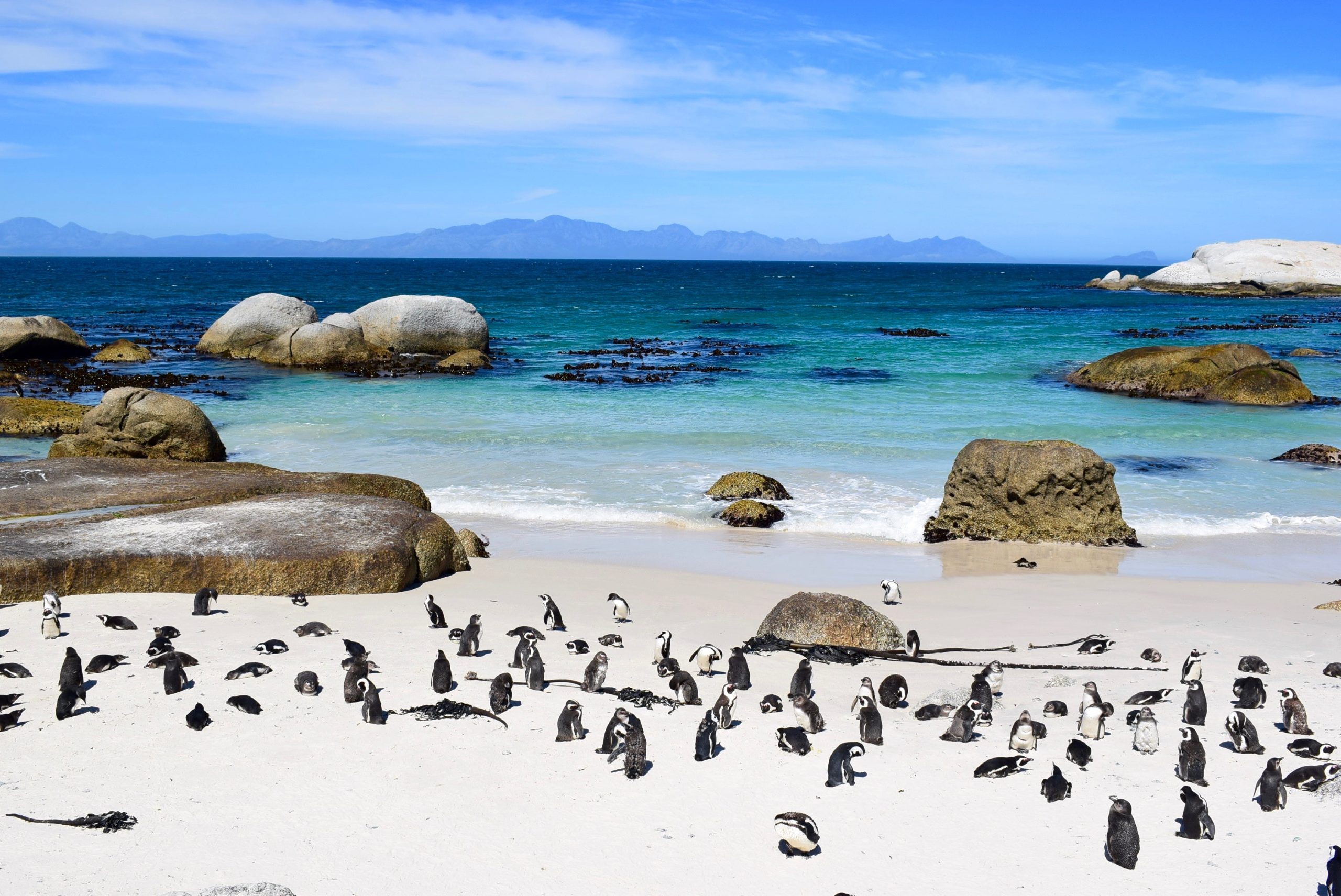
Perhaps one of the strangest sights in South Africa is a colony of African penguins waddling across sun-drenched sand at Boulders Beach near Cape Town, just down the coast from the rare fynbos plants of the Cape Floral Kingdom — proof that this country defies almost every geographic stereotype. These penguins share their coastline with an extraordinary range of marine life, thanks to the same collision of cold and warm ocean currents that create one of the richest marine ecosystems in the Southern Hemisphere.
Photo: African penguins on the sand at Boulders Beach
A Land of Superlatives
The list of “onlys” and “mosts” keeps going. South Africa is the only country in the world with three capital cities, splitting executive, judicial, and legislative power between Pretoria, Bloemfontein, and Cape Town. It produces around 70% of the world’s platinum, largely from the Bushveld Complex, one of the richest platinum deposits ever formed by ancient volcanic activity. It generates roughly two-thirds of all of Africa’s electricity and contains about 80% of the continent’s rail infrastructure. It’s home to the longest continuous wine route on Earth, winding hundreds of kilometers through the Cape Winelands. And it holds ten UNESCO World Heritage Sites, from Robben Island to the Cradle of Humankind’s fossil-rich caves and the wetlands of iSimangaliso Park, each one a testament to just how much geographic and cultural richness is packed into a single country.
Why This Country Defies Expectations
From oceans that collide at its southern tip to caves that hold the story of human origins, from a canyon draped in green to rocks older than life itself, South Africa isn’t just geographically diverse — it’s geographically unlikely. Whether you love geography, maps, travel, geology, history, or fascinating facts from around the world, this countdown is packed with incredible discoveries you probably never knew existed in one single country.